

Luxury jewelry brands pour significant budget into paid advertising yet struggle with unstable returns and disconnected customer experiences. The core issue isn't spending levels but misaligned workflows that fail to address the complex emotional and rational considerations buyers navigate. When paid media and email marketing operate independently, brands lose customers at critical decision points, undermining both performance and positioning.
Table of Contents
- Prerequisites And Tools Needed
- Understanding Luxury Buyer Psychology And Journey Complexity
- Step-By-Step Customer Journey Workflow Construction
- Channel Alignment And Personalized Messaging
- Common Mistakes And Troubleshooting
- Expected Results And Outcomes
- Optimize Your Luxury Brand's Customer Journey Today
- Frequently Asked Questions
Key Takeaways
| Point | Details |
|---|---|
| Integrated Strategy Drives Growth | Coordinating paid media and email marketing stabilizes ROI and has generated over $25 million in additional revenue for luxury brands. |
| Complex Buyer Journeys | Luxury consumers navigate approximately 17 decision points requiring emotional and rational validation. |
| Personalization Multiplies Results | Aligned workflows addressing all decision points can triple conversion rates and boost retention 15% within six months. |
| Common Failures Cost Revenue | Ignoring emotional triggers and poor channel integration cause 30% drop-off at key journey stages. |
| Data Infrastructure is Essential | Real-time analytics and testing frameworks form the foundation for sustainable workflow optimization. |
Prerequisites and Tools Needed
Before constructing effective customer journey workflows, luxury brands must establish robust data and technology foundations. Without these prerequisites, even well-designed strategies collapse under execution pressure.
Your marketing technology for luxury brands must include integrated platforms for paid media management and email automation. These systems should share data seamlessly, enabling unified customer profiles and coordinated messaging. Disconnected tools create information silos that prevent the personalization luxury buyers expect.
Baseline data collection across all customer touchpoints is non-negotiable. Track website behavior, email engagement, paid media interactions, and purchase history in a centralized system. Real-time cross-channel analytics reduce decision latency by 40%, enabling timely segmentation and personalized responses.
Essential Technology Components:
- Unified customer data platform aggregating all touchpoint interactions
- Marketing automation with advanced segmentation and workflow capabilities
- Paid media platforms supporting audience synchronization and retargeting
- Analytics infrastructure providing real-time performance visibility across channels
Understanding luxury buyer psychology is equally critical. Your team must grasp how emotional desire and rational validation interplay throughout the purchase journey. This knowledge informs messaging strategy, timing decisions, and content development at each workflow stage.
| Tool Category | Purpose | Business Impact |
|---|---|---|
| Integrated Data Platform | Unify customer touchpoint data | Enables personalization and reduces latency 40% |
| Marketing Automation | Execute coordinated email workflows | Supports lifecycle nurturing and conversion optimization |
| Paid Media Management | Align advertising with email strategy | Stabilizes performance and improves ROAS |
| Analytics Infrastructure | Monitor real-time workflow performance | Identifies optimization opportunities and conversion barriers |
Pro Tip: Establish data governance protocols before launching sophisticated workflows. Clean, consistent data is more valuable than advanced technology operating on flawed information.
These prerequisites prevent common implementation failures and create the foundation for scaling. Brands attempting workflow optimization without proper infrastructure waste resources and damage customer relationships through inconsistent experiences.
Understanding Luxury Buyer Psychology and Journey Complexity
Luxury jewelry and watch purchases represent significant emotional and financial commitments. Buyers don't impulse purchase a $15,000 timepiece. They evaluate, reconsider, and seek validation across multiple touchpoints before committing.
Research shows luxury customers face around 17 decision points requiring both emotional resonance and logical justification. Each point represents a potential conversion moment or abandonment risk. Your workflows must address every stage with appropriate messaging that balances aspiration with assurance.
Key Psychological Drivers in Luxury Purchases:
- Exclusivity and scarcity create desirability and justify premium pricing
- Brand narrative consistency builds trust and emotional connection
- Social proof from relevant peer groups validates purchase decisions
- Craftsmanship and heritage stories provide rational purchase justification
- Personalized attention reinforces buyer importance and brand commitment
The emotional investment paradox defines luxury buying behavior. Customers simultaneously need to feel special and make a smart decision. Your workflows must nurture emotional desire through storytelling and aspirational content while providing detailed product information, warranties, and value retention data that satisfy rational concerns.
Ignoring this complexity causes predictable failures. Brands focusing solely on product features miss emotional engagement opportunities. Those emphasizing only lifestyle aspiration fail to address practical purchase barriers. Both approaches leave conversion potential unrealized.
Understanding these multiple buyer motivations allows you to map workflows that guide customers through doubt and hesitation toward confident purchase decisions. Each communication should move buyers closer to resolution on both emotional and rational dimensions.
Step-by-Step Customer Journey Workflow Construction
Building effective workflows requires systematic mapping of your buyer's path from awareness through advocacy. This process transforms psychological insights and data prerequisites into executable marketing strategies.
1. Map All Decision Points
Document every emotional and rational consideration your buyers face. Interview recent customers to understand their actual journey, not your assumed path. Identify where doubt emerges, what information resolves concerns, and which touchpoints prove most influential.
2. Align Paid Media Introduction with Email Continuation
Your paid advertising establishes brand positioning and value proposition. Email marketing must continue this narrative seamlessly. If ads emphasize heritage and craftsmanship, your welcome series should expand these themes with deeper storytelling and product context.
3. Design Personalized Content Flows
Create workflow branches addressing different buyer profiles and journey stages. A first-time luxury watch buyer needs more education than a returning collector. Someone comparing brands requires different content than someone evaluating specific models.
4. Sequence Messaging for Progressive Commitment
Early touchpoints should build desire and establish emotional connection. Middle stages provide detailed information addressing rational concerns. Later communications create urgency while maintaining exclusivity through limited availability or special access offers.
5. Test and Optimize Continuously
Implement A/B testing protocols for subject lines, content formats, send timing, and offer structures. Monitor where customers stall or abandon. Refine workflows to remove friction and strengthen conversion paths.

Pro Tip: Build conversion micro-goals throughout your workflow, not just final purchase. Track email opens, website revisits, product page views, and inquiry submissions. These indicators reveal workflow effectiveness before revenue impact appears.
Examine customer journey workflow examples from successful luxury brands to understand proven patterns. Adapt frameworks to your specific products, audience, and brand positioning rather than copying approaches wholesale.
Focus on maintaining brand exclusivity throughout workflow automation. Personalization should feel like tailored attention, not mass customization. Use customer data to inform relevance without sacrificing the premium experience that defines luxury positioning.
Channel Alignment and Personalized Messaging
Separating paid media and email marketing creates performance instability that intensifies with scale. As advertising spend increases, disconnected messaging confuses customers and undermines brand perception. Alignment transforms these channels into a coordinated growth engine.
Aligning paid media and email marketing under unified strategy has generated over $25 million in additional revenue for luxury brands since 2019. This approach recognizes that customer introduction through advertising must flow naturally into ongoing email conversation. Disconnection causes the performance drops that puzzle executives watching strong ad metrics fail to convert sustainably.
Strategic Alignment Principles:
- Maintain consistent brand voice and visual identity across all touchpoints
- Use paid media audience data to inform email segmentation and personalization
- Coordinate content themes so email expands rather than repeats ad messaging
- Synchronize timing so email engagement influences paid media retargeting decisions
Data-driven personalization at each touchpoint matches content to individual buyer needs and journey stages. Someone who clicked an ad featuring vintage watches should receive emails highlighting heritage collections and restoration services. This relevance maintains engagement and accelerates decision-making.
Storytelling creates the irresistible brand narrative that luxury buyers crave. Storytelling and omnichannel engagement improve brand perception and customer loyalty in luxury watch brands. Your aligned channels should collaboratively build a narrative arc that positions purchase as the natural culmination of an exclusive relationship.
| Approach | Channel Management | Customer Experience | Revenue Stability | Optimization Efficiency |
|---|---|---|---|---|
| Disjointed | Separate teams, inconsistent messaging | Confusing, repetitive touchpoints | Unstable, unpredictable | Low, data silos prevent insight |
| Aligned | Unified strategy, coordinated execution | Seamless, progressive journey | Stable, scalable growth | High, shared data enables rapid iteration |
Poor alignment between channels leads to unstable marketing ROI and performance drop-offs that frustrate executives and waste budget. Customers receive conflicting messages, experience jarring transitions between touchpoints, and lose confidence in brand professionalism.
Avoid these misalignments by establishing clear communication protocols between paid media and email teams. Share performance data, coordinate content calendars, and evaluate success based on combined channel contribution rather than isolated metrics. This integration stabilizes performance and creates the foundation for sustainable scaling.
Common Mistakes and Troubleshooting
Even sophisticated luxury brands make predictable errors when implementing customer journey workflows. Recognizing these pitfalls early prevents costly performance degradation and customer relationship damage.
Frequent Implementation Failures:
- Neglecting emotional triggers in favor of product specifications and rational benefits
- Managing paid media and email marketing as separate initiatives without coordination
- Applying generic personalization rather than luxury-appropriate tailored experiences
- Failing to test workflow performance and identify conversion dead zones
- Scaling spend before validating channel alignment and message consistency
Ignoring emotional triggers causes severe customer drop-off at key decision points. Over 30% abandonment occurs when luxury brands focus exclusively on product features without addressing the aspirational and identity dimensions buyers seek. Your workflows must balance desire cultivation with practical information delivery.
Disjointed channel management undermines both performance and efficiency. When paid media and email teams operate independently, they duplicate efforts, send conflicting messages, and miss optimization opportunities visible only through integrated data analysis. This separation becomes more destructive as marketing investment increases.
Lack of personalization diminishes engagement and brand loyalty in markets where customers expect recognition and tailored attention. Generic email blasts and broad retargeting campaigns signal that your brand views customers as transactions rather than relationships. This perception directly contradicts luxury positioning.
Practical Troubleshooting Steps:
- Audit current workflows to identify where emotional storytelling is absent or weak
- Map all customer touchpoints to reveal disconnects between paid media and email messaging
- Interview customers who abandoned purchase to understand unaddressed concerns or barriers
- Implement conversion tracking at each workflow stage to pinpoint drop-off locations
- Review personalization logic to ensure data application enhances rather than compromises exclusivity
Pro Tip: Establish routine A/B testing protocols and monthly data review sessions involving both paid media and email stakeholders. Collaborative analysis surfaces insights that isolated channel reviews miss and accelerates optimization cycles.
Fix channel integration issues by creating unified customer profiles that inform both advertising and email decisions. When paid media specialists see email engagement data and email marketers understand ad interaction history, coordination becomes natural rather than forced.
Incorporate emotional storytelling throughout your workflows by developing content that connects product features to buyer identity and aspiration. A watch isn't just precise engineering. It's a statement of values, an heirloom, a marker of achievement. Your messaging should reflect these deeper meanings.
Expected Results and Outcomes
Implementing aligned customer journey workflows generates measurable business improvements within predictable timeframes. Understanding realistic benchmarks helps you set appropriate expectations and allocate resources effectively.
Sustained workflow alignment increases customer retention by over 15% within six months of implementation. A luxury retailer achieved 15% retention growth and 12% transaction value increases through comprehensive journey mapping and workflow optimization. These gains compound over time as retained customers generate additional purchases and referrals.
Average transaction values grow 12% or more when workflows effectively nurture buyers toward premium products and collections. By addressing concerns and building confidence throughout the journey, you reduce price sensitivity and increase purchase ambition.
Comprehensively addressing all 17 decision points in the luxury buyer journey can triple conversion rates compared to generic workflows. Each resolved doubt and answered question removes friction that causes abandonment. The cumulative effect dramatically improves efficiency of marketing investment.
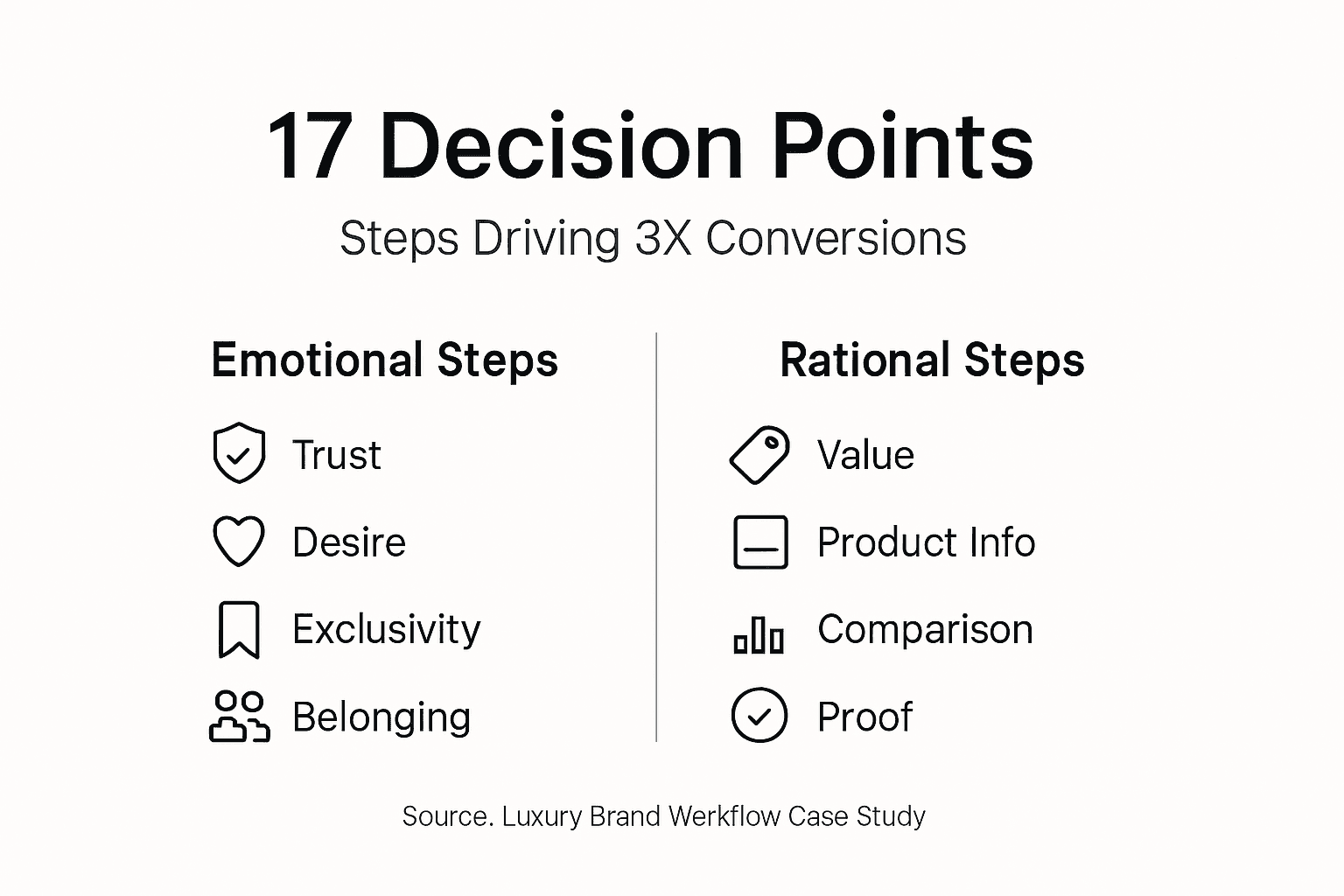
Customer lifetime value increases more than 200% through sustained personalized engagement that transforms one-time buyers into brand advocates. Workflows extending beyond initial purchase into ownership experience and repurchase cultivation unlock this long-term value.
| Metric | Baseline | 6-Month Target | 12-Month Target | Key Drivers |
|---|---|---|---|---|
| Customer Retention Rate | Industry avg 35% | 50%+ | 60%+ | Personalized post-purchase engagement, aligned messaging |
| Average Transaction Value | Baseline | +12% | +20% | Confidence building, premium product nurturing |
| Conversion Rate | Baseline | 2-3x | 3-4x | Comprehensive decision point coverage, friction removal |
| Customer Lifetime Value | Baseline | +150% | +200%+ | Repeat purchase workflows, advocacy cultivation |
These outcomes require disciplined execution and ongoing optimization. Brands achieving superior results share common characteristics including strong data infrastructure, genuine channel alignment, and commitment to testing and refinement.
Realistic timelines matter for resource planning and stakeholder management. Initial workflow improvements appear within 30 to 45 days as messaging alignment reduces confusion. Substantial revenue impact typically materializes in months three through six as enough customers complete optimized journeys to generate statistical significance.
Long-term value accumulates through retained customer relationships and improved acquisition efficiency. Brands maintaining workflow discipline for 12 months or longer see luxury customer journey success benchmarks exceed initial projections as refinements compound and customer advocacy generates organic growth.
Optimize Your Luxury Brand's Customer Journey Today
The strategies outlined in this guide have driven measurable revenue growth for luxury jewelry and watch brands facing the same challenges you encounter. Implementing aligned workflows requires specialized expertise in both luxury buyer psychology and integrated marketing execution.
Horologikal works exclusively with luxury and high-consideration brands to align paid media and email marketing under coordinated strategies that stabilize performance and drive sustainable revenue growth. Our approach recognizes that customer introduction through advertising must flow seamlessly into ongoing email conversation, creating the cohesive experience luxury buyers expect.
Explore Horologikal luxury marketing solutions designed specifically for jewelry and watch brands navigating complex buyer journeys. Our personalized opt-in strategies for luxury brands help you capture and nurture high-intent prospects through workflows addressing all 17 decision points in the luxury purchase journey.
Ready to transform disconnected marketing channels into a unified growth engine? Schedule a consultation to optimize your workflow and discover how aligned paid media and email marketing can multiply your conversion rates while strengthening brand positioning.
Frequently Asked Questions
What is the typical timeline to see ROI from customer journey workflow optimization?
Initial improvements appear within 30 to 45 days as messaging alignment reduces customer confusion and drop-off. Substantial revenue impact typically materializes in months three through six as sufficient customers complete optimized journeys to generate measurable results. Long-term value compounds over 12 months as refinements accumulate and retained customers drive organic growth.
How can luxury brands maintain exclusivity while personalizing messaging at scale?
Use customer data to inform content relevance without sacrificing premium brand experience. Personalization should feel like tailored attention from a knowledgeable specialist, not mass customization. Focus on matching content to buyer interests and journey stage while maintaining sophisticated tone, visual quality, and brand narrative consistency that signals exclusivity.
What are the best metrics to track to evaluate workflow effectiveness?
Monitor conversion micro-goals throughout the journey, not just final purchase rates. Track email engagement, website revisit frequency, product page depth, inquiry submissions, and time between touchpoints. These leading indicators reveal workflow health before revenue impact appears. Also measure customer retention, average transaction value, and lifetime value to assess long-term effectiveness.
How often should workflows be tested and optimized?
Implement continuous A/B testing for subject lines, content formats, send timing, and offer structures. Conduct comprehensive workflow reviews monthly, analyzing where customers stall or abandon. Make incremental refinements based on data patterns rather than intuition. Quarterly, assess overall strategy alignment and major structural adjustments based on cumulative learnings.
Can small luxury brands implement these sophisticated workflows effectively?
Yes, with proper prioritization and phased implementation. Start with essential infrastructure including unified customer data and integrated marketing platforms. Focus initial workflows on highest-value journey segments rather than attempting comprehensive coverage immediately. Small brands often achieve faster iteration cycles and more authentic personalization than larger organizations constrained by complexity and bureaucracy.